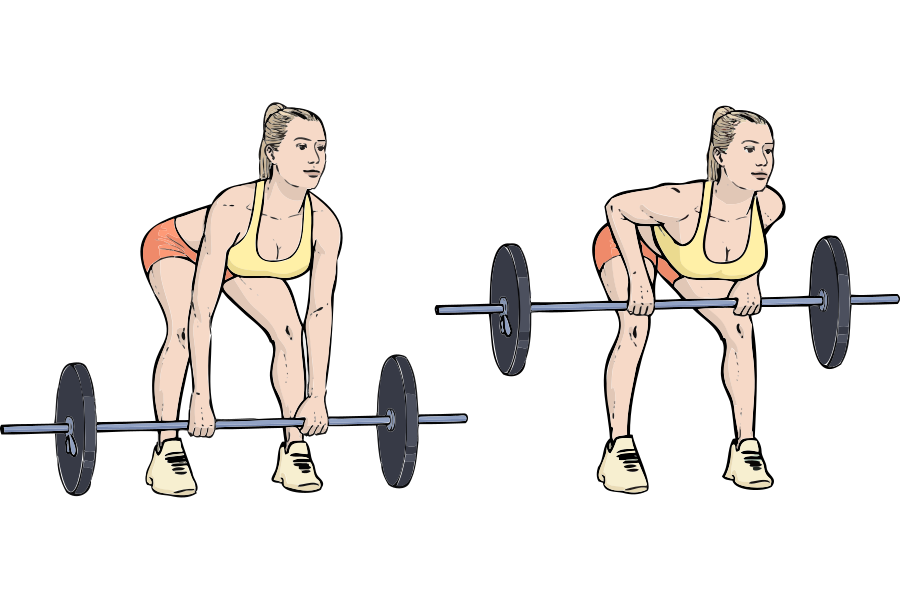
This advanced gym workout overloads your pulling muscles — back and biceps — for serious upper-body power. Make your primary focus hitting those reps! Ideally, you hit failure right as you finish. Push the resistance here!
Pull Muscle Power Overload 52-min Gym Workout is a free 52 min workout plan with 8 illustrated exercises for your abs, arms, back and chest. Follow the workout online, save it to your WorkoutLabs Fit account or download it as a printable PDF.
Tap any exercise in the workout to see the muscles worked, clear exercise illustrations and step-by-step instructions. Each workout includes sets, reps, rest times and notes so you can follow the plan without guessing.
You'll need full gym for this workout. Tap any exercise to see form instructions and possible substitutions if a piece of equipment isn't available.
How long does the Pull Muscle Power Overload 52-min Gym Workout take?
The full workout takes about 52 minutes, covering 8 exercises with prescribed sets, reps and rest periods. Using the built-in timers and auto-advance keeps you on pace from start to finish.
Is this workout suitable for my fitness level?
This is an advanced workout designed for experienced lifters. If you're newer to training, scale it down with lighter loads and longer rests, or browse our library for a beginner or intermediate version of a similar routine.
What muscles does this workout target?
This routine primarily works your lower back, upper back & lower traps, abs, chest, shoulders, middle back / lats. Tap any exercise in the workout to see a muscle diagram showing exactly which primary and secondary muscles it activates.
How often should I do this workout?
For gain muscle, get toned, aim to do this workout 2–3 times per week with at least one rest day between sessions. Progress by gradually adding weight or reps, and pair it with workouts for other muscle groups during the week.
Can I download or save this workout?
Yes – you can download this workout as a free printable PDF using the download button, or save it to a free WorkoutLabs Fit account to follow it on your phone, customize the exercises and track your progress.
This advanced gym workout overloads your pulling muscles — back and biceps — for serious upper-body power. Make your primary focus hitting those reps! Ideally, you hit failure right as you finish. Push the resistance here!
Auto-advanceStart exercises automatically after a 5-second delay
Reach up and grip the bar with an overhand grip with both hands.
Keeping your body straight, pull yourself up towards the bar by pulling your elbows as far back as you can and trying to touch the bar with your chest.
Hold and squeeze your arm and back muscles.
Lower yourself back to the start position in a controlled motion.
Repeat.
For this exercise, you can use a Smith machine bar, an Olympic bar on a rack or any other straight, sturdy bar set to the right height. The lower the bar is to the floor, the more intense it will be due to the starting angles of your arms.
Standing under a pull-up bar, reach up and hold onto the bar with an overhand grip. Make sure your hands are about twice your shoulder width apart.
Keep your arms straight and hang from the bar so that your arms are taking all of your weight.
Keeping your body straight and not swinging your weight, pull your body up towards the bar by pulling your elbows down towards your torso at an angle.
Continue lifting until your chest is nearly touching the bar. You should feel a “squeeze” at the base of your lats (about midway down your back and to the side) as they contract.
Once your lats have completely contracted at the top of the movement, slowly lower your body to the starting position.
Repeat.
By using a wide grip, your lats are doing most of the lift, rather than your biceps. It doesn't matter if you keep your legs straight or bent at the knees with your feet crossed. The important thing is that you do not use your legs to assist in lifting your body weight. As your strength increases, you can add weight by using a weight belt.
Bend your torso from the waist until your upper body is parallel to the floor, while placing your right hand on the bench in front of you for support.
With your left hand, pick up the dumbbell with an overhand grip. The palm of your hand should be facing into you.
Keep your lower back straight. This is the start position.
Using your back muscles, pull the dumbbell straight up to the side of your chest, keeping your upper arm close to your side. Exhale as you do so.
At the top of the movement, hold for a count of one and squeeze your back muscles.
Return to the start position inhaling as you do so. Repeat.
Complete all repetitions for one side before switching sides.
This exercise can be performed using a cable station, with a stirrup handle attached to either the high or low pulley.
Primary muscle group(s):
Lower Back
Secondary:
Abs, Biceps
Stand tall with a tight core and flat back. Hold a pair of dumbbells at your side with an overhand grip. Bend slightly at the knees as you push your hips back. Keep your chest and head up. Upper body should be almost parallel with the floor.
With your elbows at a 60-degree angle, bring the dumbbells up. Pause when your upper arm is parallel with the floor. Contract the muscle then slowly return the dumbbells to the starting point.
Primary muscle group(s):
Middle Back / Lats
Secondary:
Abs, Biceps
Begin the movement by stepping on to a resistance band with your feet at shoulder-width, toes pointed slightly out.
Bend slightly at the knees and forward at the hips. Maintain a braced core and flat back throughout.
Leading with your elbows, pull the handles of the resistance band back, bringing your shoulder blades closer together. Hold this contraction and slowly release to the starting position.
Primary muscle group(s):
Middle Back / Lats, Upper Back & Lower Traps
Secondary:
Biceps
Stand tall with a tight core and flat back. Hold a pair of water bottles at your side with an overhand grip. Bend slightly at the knees as you push your hips back. Keep your chest and head up. Upper body should be almost parallel with the floor.
With your elbows at a 60-degree angle, bring the water bottles up. Pause when your upper arm is parallel with the floor. Contract the muscle then slowly return the water bottles to the starting point.
Connect a V-bar attachment to the low pulley on a cable station or cable rowing machine.
Sit down at the station and place your feet on the foot pads or crossbar provided, while keeping your knees slightly bent.
Lean forward, keeping your back straight and grip the V-bar handles with both hands.
Keeping your arms fully extended pull back until your torso is at a 90-degree angle from your legs.
Your back should be slightly arched, with your chest should be pushed out. This is the start position.
Keeping your torso stationary, pull the handles back towards you while squeezing your back muscles.
Keep your arms close to your sides until your hands reach your abdomen. Exhale as you perform this movement.
Hold for a count of one.
Inhale as you return to the start position in a smooth movement.
Repeat.
Do not swing or rock back and forth as you perform this exercise. Doing so can cause lower back injury. <strong></strong> You can perform this exercise using a straight bar instead of a V-Bar. You can use an underhand or overhand grip.
Primary muscle group(s):
Lower Back
Secondary:
Abs, Biceps
Stand tall with a tight core and flat back. Hold a pair of dumbbells at your side with an overhand grip. Bend slightly at the knees as you push your hips back. Keep your chest and head up. Upper body should be almost parallel with the floor.
With your elbows at a 60-degree angle, bring the dumbbells up. Pause when your upper arm is parallel with the floor. Contract the muscle then slowly return the dumbbells to the starting point.
Primary muscle group(s):
Middle Back / Lats, Upper Back & Lower Traps
Secondary:
Biceps
Stand tall with a tight core and flat back. Hold a pair of water bottles at your side with an overhand grip. Bend slightly at the knees as you push your hips back. Keep your chest and head up. Upper body should be almost parallel with the floor.
With your elbows at a 60-degree angle, bring the water bottles up. Pause when your upper arm is parallel with the floor. Contract the muscle then slowly return the water bottles to the starting point.
Primary muscle group(s):
Middle Back / Lats
Secondary:
Abs, Biceps
Begin the movement by stepping on to a resistance band with your feet at shoulder-width, toes pointed slightly out.
Bend slightly at the knees and forward at the hips. Maintain a braced core and flat back throughout.
Leading with your elbows, pull the handles of the resistance band back, bringing your shoulder blades closer together. Hold this contraction and slowly release to the starting position.
Sit on a flat bench with your legs spread, knees bent and your feet flat on the floor with a dumbbell between your feet.
Use either arm to pick the dumbbell up and hold it with an underhand grip.
Place the back of that upper arm on the top of your inner thigh on the same side. Your palm should be facing away from your thigh.
Keep your arm fully extended downwards without letting the dumbbell rest on the floor. This is the start position.
Curl the dumbbell forward and up in a smooth arc, contracting your biceps and exhaling.
Continue curling the dumbbell upward until your biceps are fully contracted and the dumbbell is at shoulder level. Hold for a count of one while squeezing your biceps.
Return to the start position in a controlled, smooth arc inhaling as you do so. Do not swing the dumbbell down.
Repeat for all the repetitions for that arm then switch and repeat the movement with your other arm.
Throughout this exercise, only your forearms should move. This exercise can be performed standing in a bent over position. Here there is no upper arm support so it's important to ensure there is no movement or swinging of the upper arm. This harder version of concentration curls isn't recommended for people who suffer lower back issues.
Primary muscle group(s):
Biceps
Secondary:
Abs, Forearms
Set up an incline bench at 45 degrees.
Holding a dumbbell in each hand, sit on the bench, keeping your shoulders and back firmly against the back rest.
Put your arms down by your side with your palms facing in to your body.
Slowly curl your arms up, rotating your wrist outwards (thumbs pointing away from your body) until the dumbbell is level with your shoulders. (Your palms should be facing your shoulders)
Flex or squeeze your bicep at the top of the movement and hold for a count of one.
Slowly lower the dumbbells back to the start position, turning your palms back in to your body. Repeat.
You can also perform this exercise using one arm at a time or by alternating your arms (Left, right, left, right...)
Primary muscle group(s):
Biceps
Secondary:
Forearms
Set up a preacher curl bench making sure that the seat is set at the right height for you. The seat shouldn’t be so low that you need to raise your shoulders, or so high that you need to lean over the support pad.
Rest you arms on the support pad with your triceps near the top and your elbows midway down the pad.
Grip the EZ curl bar with an underhand grip at shoulder width.
Curl the bar in towards your chin and upper chest in a single smooth arc. Hold for a count of one.
Lower the bar by extending your arms back to the starting position.
This exercise is designed to isolate and focus attention on the biceps. Therefore, resistance is stronger at the start of each repetition. So when you begin each repetition, don't explode upwards too quickly!
Primary muscle group(s):
Biceps
Secondary:
Forearms
Begin the movement by stepping on to a resistance band with your feet at shoulder-width, toes pointed slightly out.
Holding the handles of the band in each hand, tighten your abdominals and straighten your lower back. Keep your chest up and gaze forward.
Using an underhand grip or hammer fist grip, slowly pull the band towards your shoulders. Keep your upper arm in place, moving only your forearms.
Once you reach the top of the movement, pause, and slowly lower the band to the starting position. Do not lock out your elbows.
Primary muscle group(s):
Biceps
Secondary:
Forearms
Holding a water bottle in each hand, stand with your feet shoulder width apart.
Let your arms hang by your side with your palms facing in to the side of your body.
Keep your elbows close to your sides.
Curl the water bottles up towards your shoulders. Do not swing your hips to get the weight moving.
Continue raising the water bottles until they are level with your shoulders with your palms facing in. Your forearm should be in a vertical position.
Squeeze or flex your bicep and hold for a count of one.
Slowly lower the water bottles to the starting position.
Stand straight holing a dumbbell in each hand with a neutral grip.
Keep your arms fully extended with your palms facing in to your sides.
Keep your elbows tucked in to your sides. This is the start position.
Keeping your upper arm stationary, exhale and curl the dumbbells up towards your shoulders.
Continue raising the dumbbells until your biceps are fully contracted and the dumbbells are at shoulder level.
Hold for a count of one and squeeze your biceps.
Return to the start position in a smooth movement, inhaling as you do so.
Repeat.
There are many ways to perform this movement. Other examples include; sitting with or without back support, using alternating arms and also using a cable station's lower pulley.
Primary muscle group(s):
Biceps
Secondary:
Forearms
Stand at the cable station with your feet shoulder width apart and with a slight bend at the knee.
Grasp the rope with both hands and your palms facing inward.
Keeping your core strong and your elbows fixed at your sides pull the rope towards the top of your chest (only the lower portion of your arms should be moving).
Tense your biceps at the peak, and then slowly allow the rope to be pulled back down to the starting position.
Workout done!
Exercises done
of 8
Total time
Access 1000+ more workouts, build your own plans and track progress with Fit